
What’s Really Behind the 2026 Rise in Interest Rates? (Updated)
The sharp rise in long-term interest rates has become one of investors’ biggest concerns in 2026. The usual explanations point to renewed inflation or deteriorating confidence in U.S. government finances.
The evidence suggests a different story. Inflation expectations have moved little, the dollar has strengthened, and yields have risen across other developed markets as well. A more convincing explanation is a broader repricing of long-term capital, driven by heavy borrowing, strong investment demand, changing monetary-policy expectations, and a higher premium for holding longer-term bonds.
For investors, the key question is not simply why rates are rising, but whether today’s higher yields represent a temporary adjustment or a more lasting return to a world in which capital once again carries a meaningful cost. The answer has important implications for bonds, equities, credit markets, and portfolio construction.
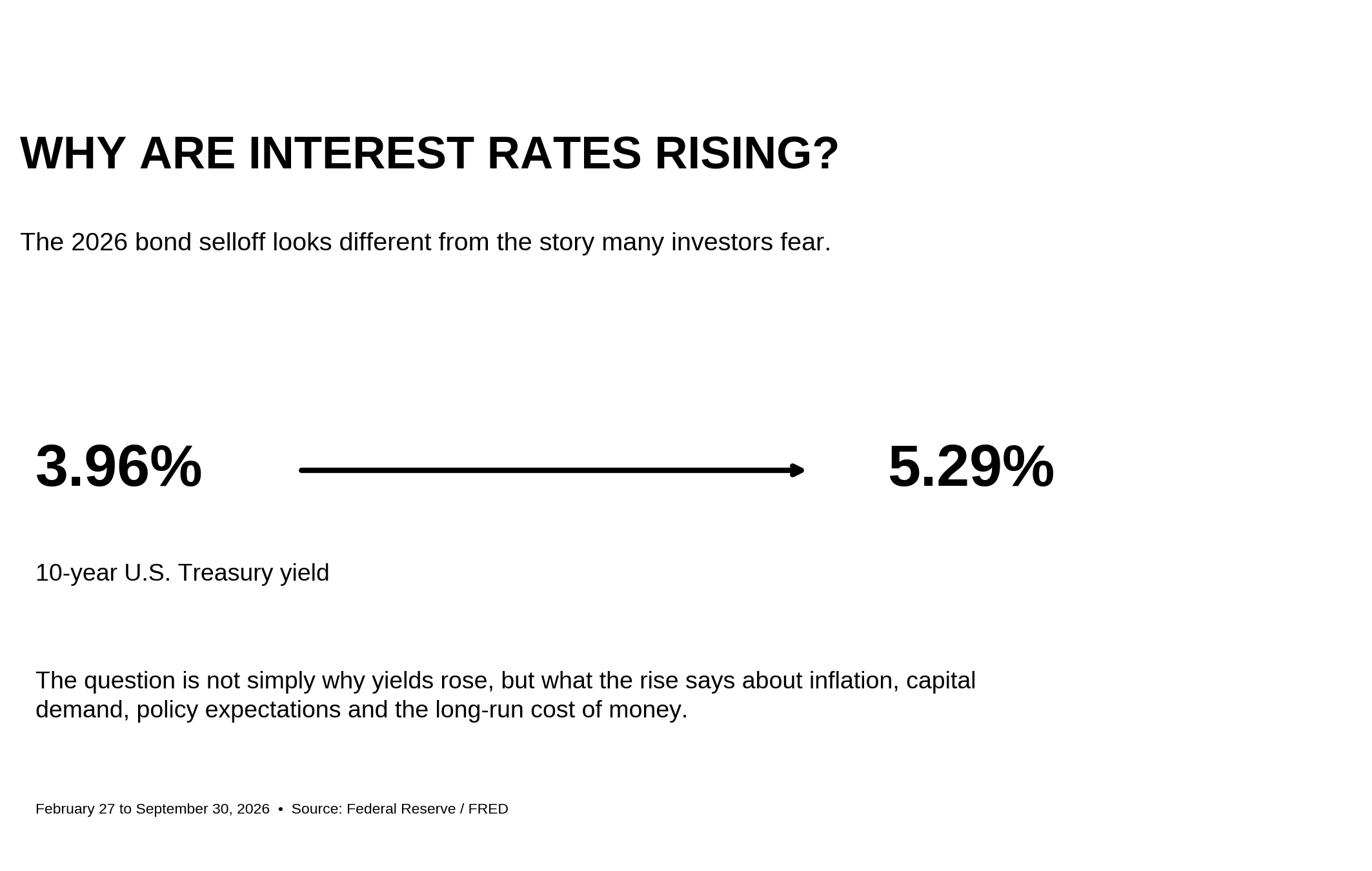
From February to September 2026, the benchmark 10-year U.S. Treasury yield rose by 133 basis points, from 3.96% to 5.29%. By recent historical standards, that represents a very large increase over a comparatively short timeframe. In only two of the previous 30 years - 1999 and 2022 - did the 10-year rate increase by as great an amount over a seven-month period.
Various reasons that have been proposed for the dramatic upturn in U.S. interest rates have disturbing implications for investors. The upsurge has been attributed to escalating inflation expectations and even a loss of confidence in the American government’s ability to honor its future debt obligations. Those explanations, however, do not appear to be the principal drivers of the move. Instead, the facts point to a different, and in important respects less ominous, mix of causes underlying the interest rate escalation.
A key to understanding what has happened is to bear in mind that a nominal Treasury yield can be thought of as reflecting three broad elements:
Expected real short-term rates, which reflect the inflation-adjusted cost of money over time.
A term premium that investors demand for locking up their capital for an extended period instead of rolling over several shorter-term loans in succession.
Inflation compensation, reflecting expected inflation as well as compensation for uncertainty about future inflation.
The Culprit Was Not a Rise in Inflation Expectations
Treasury Inflation-Protected Securities (TIPS) provide a market-based measure of investors’ inflation compensation. It consists of the yield difference between conventional U.S. Treasury bonds and TIPS. Between February 27 and September 30, the ten-year TIPS-implied “breakeven inflation” rate rose by just 11 basis points, from 2.25% to 2.36%.

That means roughly 122 of the 133 basis points in the nominal 10-year yield — about 92% of the total — reflected a rise in the 10-year real TIPS yield rather than higher inflation compensation. This is the central fact of the 2026 move. The real TIPS yield, however, is not a pure measure of expected real growth or future Federal Reserve policy; it can also incorporate a real term premium.
Rising Rates Not Explained by Loss of Confidence in U.S. Sovereign Credit
The increase in real yields clearly accounts for most of the rise in the nominal (non-inflation-adjusted) 10-year Treasury rate, but real yields themselves have multiple components. One explanation that has been proposed for 2026’s rise is mounting concern about the U.S. government’s credit quality. According to this school of thought, investors are demanding a higher yield on Treasury bonds because they fear that uncontrolled deficit spending, resulting in sharply escalating federal debt, could eventually impair the U.S. government’s credit standing.
That line of reasoning is logically valid and the U.S. fiscal situation is definitely worsening. The International Monetary Fund (IMF) projects that gross U.S. sovereign debt will increase to 125.8% of Gross Domestic Product (GDP) in 2026 from 123.9% in 2025 and to 142.1% in 2031. The facts do not, however, support a claim that U.S. fiscal policy was the principal driver of the recent interest rate surge. The rate on the five-year U.S. sovereign credit default swap (CDS) provides a market-based gauge of investors’ perception of default risk on Treasury obligations. It ended September at roughly 36 basis points, and its movement over the period was small in comparison with the 133-basis-point rise in the 10-year Treasury yield. CDS is not a pure measure of default probability, but it does not show a deterioration in perceived U.S. credit quality remotely comparable to the move in Treasury yields.
Deteriorating confidence in U.S. creditworthiness would normally be expected to put downward pressure on the dollar in the foreign exchange market. Instead, as measured by the U.S. Dollar Index (DXY), the dollar appreciated by +3.9%. A possibly superior exchange rate measure, the Fed’s exchange-weighted index of advanced economies, puts the dollar’s appreciation at +2.4%. Either way, the data do not support the notion that Treasury yields rose mainly because investors became more fearful of a U.S. sovereign default.
A Stronger Candidate: Global Repricing of Long-Term Debt
Money manager Michael Green argues that instead of being a function of waning confidence in U.S. creditworthiness, the rise in Treasury rates was part of a global repricing of long-term debt. For example, Germany is widely regarded as a model of fiscal prudence among sovereign borrowers. The yield on its 10-year sovereign bonds increased by 94 basis points between February and September. Sovereign yields also rose, although not by as much, in some other countries that the CDS market deems fiscally sounder than the U.S., such as Switzerland and Norway.

In other words, borrowing costs went up on a comparable scale in countries that are under no suspicion of escalating default risk. This does not prove that U.S. fiscal policy was irrelevant, but it does show that an explanation centered solely on U.S. specific credit deterioration is incomplete.
Neither has fiscal improvement shielded countries from the fate of higher interest rates. For example, the IMF projects that Japan’s gross government debt as a percentage of GDP will drop from 204.4% in 2026 to 192.8% in 2031. Nevertheless, Japan’s 10-year government bond yield jumped by 94 basis points between February and September.
Supply of Global Debt
Another potentially important explanation that has been offered for the rise in U.S. interest rates avoids the problem of being undercut by the coinciding rise in other countries’ rates. It holds that borrowing costs have climbed because the supply of debt has expanded without a fully offsetting rise in investor demand. A conspicuous source of the new supply is the financing of data centers. Hyper-scalers, notably Alphabet (GOOG) and Amazon (AMZN), have raised substantial amounts of debt in Europe.
Data center construction has received the most publicity, but other categories of capital spending are also currently running at high levels. They include semiconductor manufacturing, AI computing equipment, factory automation, and robotics. Unlike a pure inflation shock or a sovereign-credit crisis, these expenditures add to productive capacity and GDP, although the debt issued to finance them can still put upward pressure on long-term yields.
Other Proposed Explanations of the Rise in Real Yields
As noted above, the real yield is multifaceted. It clearly emerges as the primary source of the rise in Treasury yields, given the limited movement in inflation compensation. The term premium, however, cannot be eliminated as an explanation; Federal Reserve estimates suggest that it rose materially. There is room for debate about how much of the increase in real yields came from a higher term premium, changing expectations for future short-term real rates, and other factors. Attributing part of the rise to the increased supply of global debt is a credible interpretation, but there is no simple way of quantifying the relationship between the two.
Focusing on the U.S., macro strategist Jim Bianco points out that total (government and nongovernment) debt as a percentage of GDP reached 370% in 2Q 2026. That is almost exactly where the ratio stood in September 2006; it has been both higher and lower in the interim. Since the Global Financial Crisis in 2009, government debt has increased dramatically as a percentage of GDP, but nongovernment indebtedness has declined by the same measure.
Combined government and corporate interest costs are now 3.8% of GDP, not far above the 65-year average of 3.5% and considerably below the 5.9% peak reached in 2008. By Bianco’s reckoning, these figures do not point to unusual upward pressure on interest rates. He instead contends that rates merely rose to come into line with the state of the economy after being misaligned on the downside for an extended period.
Economist David Rosenberg has an alternative explanation. He attributes part of the sharp increase in Treasury rates to a policy risk premium. This premium, in his view, arises from concerns about government spending shocks and potential shifts in the Fed’s management of short-term interest rates, and could appear in higher real yields and term premia.
Still another, more speculative, explanation for at least a portion of the interest rate increase comes from economist David Ranson. His framework for interpreting markets is that Treasury bonds and gold are safe havens, while stocks and commodities are risky assets. The recent price advances in equities and commodities, while bonds and gold have retreated, suggest that macro risk has diminished. Ranson believes investors have become less concerned about the risk of a prolonged, intensive conflict involving the U.S. and Iran. In his view, that reduction in macro risk could have contributed to lower bond prices and therefore higher interest rates.
Conclusion
Although it is not feasible to allocate precisely the February-to-September rise in the 10-year Treasury yield among higher expected real short-term rates, a higher term premium, and the other factors described above, the evidence argues against two of the most ominous explanations: (1) a major unanchoring of long-term inflation expectations or (2) a broad loss of confidence in U.S. sovereign credit. That does not mean the increase in rates is harmless. Higher real yields and term premia raise borrowing costs and discount rates across the economy.
To the extent that part of the rise reflects corporations’ appetite for debt capital, however, it points to strong demand for investment capital rather than a credit crisis. It also suggests that when the AI-driven spending boom runs its course, one source of upward pressure on rates may ease. Rates need not, however, return to the very low levels of the pre-2026 period if equilibrium real rates or term premia have shifted structurally higher.
Investment strategist Ian Hartnett sees positives in the real rate escalation that has occurred. He expects it to strengthen the competitive position of banks at the expense of non-bank financial institutions that have relied on cheap funding and skewed business activity in the direction of financial engineering. A turn toward more fundamentally grounded earnings growth should boost investor confidence over the longer term, says Hartnett. Additionally, he maintains, the increase in real rates restores bonds’ stature as an option for asset allocators following an extended period of low expected bond returns that made no alternative to equities appear worthwhile. Bonds are now more competitive, given the modest returns that stocks have historically generated following periods of elevated price-earnings multiples like the present.
In summary, investors should not accept at face value the easy explanations of this year’s rise in interest rates. Yes, the CPI inflation rate has risen, but that has not produced a significant increase in long-term inflation compensation, which is what matters most for long-term bond yields. Neither does the story of declining confidence in U.S. creditworthiness appear to explain the bulk of the move. The better-supported explanation is a global repricing of real yields and term premia, influenced by stronger capital demand, heavy public and private debt supply, monetary-policy expectations, and policy risk.
That picture is less ominous than a runaway-inflation or U.S.-sovereign-credit crisis, but it is not benign in every respect: a world of structurally higher real rates would still have important consequences for borrowers, asset valuations, and portfolio construction.
The key question is not simply why rates are rising, but whether today's higher yield represent a temporary adjustment or a more lasting return to a world in which capital once again carries a meaningful cost.
Comments